Social Care
Supporting the Social Care workforce

Adult Social Care Workforce Data Set (ASC-WDS)
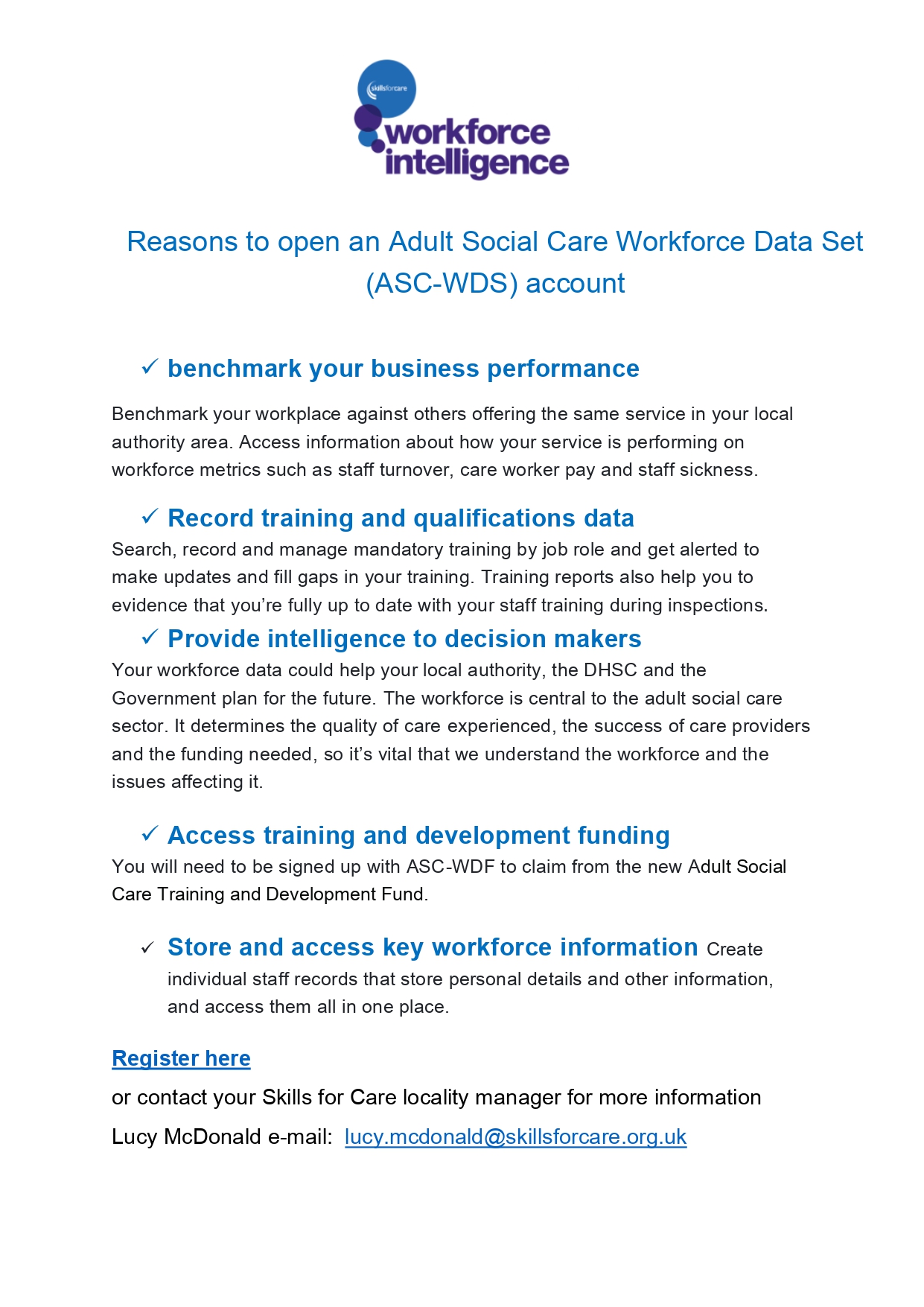
Click on the button below to read the reasons to open an Adult Social Care Workforce Data Set (ASC-WDS) account

Support to care homes training Tier 3 Free Education Offer – Pressure Ulcer Prevention
February 18 @ 11:00 am - 12:00 pm
Continuing Health Care Fast Track Pathway Training (February 2026)
February 19 @ 2:00 pm - 4:00 pm
Dysphagia Safety
February 19 @ 2:00 pm - 3:00 pm
Mental Health Awareness
February 19 @ 2:00 pm - 4:00 pm
News and Resources
We Are Social Care Nursing newsletter shares and celebrates the exceptional work being done by nurses and nursing associates working in social care. The aim is to highlight and showcase what is going on in nursing, to give a voice to the nurses and nursing associates who are working in social care, and for colleagues to better understand the complexity of the roles. Sign up to We Are Social Care Nursing
The Nursing News newsletter aims to provide insight into some of the nursing related activities that Skills for Care is both involved in and aware of, across the country. With 33,000 registered nurses working in social care and a further 6,700 in other roles, and nursing associates, we aim to highlight national and local priorities that have an impact on nursing within social care. We want to focus on, support, and promote, the role of nursing within the social care sector. Sign up to Nursing News
Statutory and mandatory training guide for adult social care employers
Produced in partnership with a panel of social care employers, learning providers and representative organisations and updated in-line with CQC’s revised inspection framework and the Workforce Strategy for adult social care in England. The guide covers statutory and mandatory knowledge and skills in a variety of topic areas based on a review of legislation, guidelines, statutory guidance, standards and recommendations. Find the resource here
New induction toolkit Plan and deliver a supportive and inclusive induction for new starters at all levels across all types of roles in adult social care find it here
International recruitment toolkit for social care
Produced by the Department of Health and Social Care and Skills for Care to support providers to ethically recruit care workers and senior care workers from overseas Find this on our website, alongside other key resources and information to support with ethical international recruitment. Visit the webpage
Managing multiple workplaces in ASC-WDS is easy Did you know you can record and manage lots of workplaces in the Adult Social Care Workforce Data Set (ASC-WDS) using just one account? It’s called a ‘parent’ account and it can help you and others save time adding data to the service across your entire organisation. We’ve recently updated our information and experience for ‘parent’ account holders. This includes a new ‘parent’ homepage and easier navigation between workplaces.. ⇨ Login or sign-up to ASC-WDS account to find out
Birmingham and Solihull Integrated Care Board (BSOL) Quality Team – web page (Information for Birmingham and Solihull Care Homes)
BSOL ICB Quality Team Web Page which includes information on;
- Falls resources New
- Dysphagia and swallowing resources New
- Continence resources New
- Clinical Learning Alerts
- Quality improvement resources
- Best practice information
If you would like more information about the BSOL Quality Team, please contact nhsbsolicb.qualitychc@nhs.net
Social care nursing placements offer a wealth of opportunity with employers and practice learning partners playing a key role in supporting students to reach their full potential in developing their knowledge and skills within the learning environment.
With an ongoing demand for nurses and nursing associates within the sector there is a need to increase placement capacity. This guidance is aimed at employers and those considering hosting students to help them navigate the process of linking in with higher education institutions and highlights the benefits that there are for employers in hosting students.
It’s been developed in collaboration with:
- higher education institutions nationally
- student nurses and nursing associates
- employers who are already hosting students
- regional integrated care boards
- Nursing and Midwifery Council and partner agencies who are committed to increasing placement capacity within social care.
How to make the most of student nurse placements in social care settings
Supporting the understanding of nursing placements within social care. This guide is aimed at social care employers, student nurses and higher education providers.
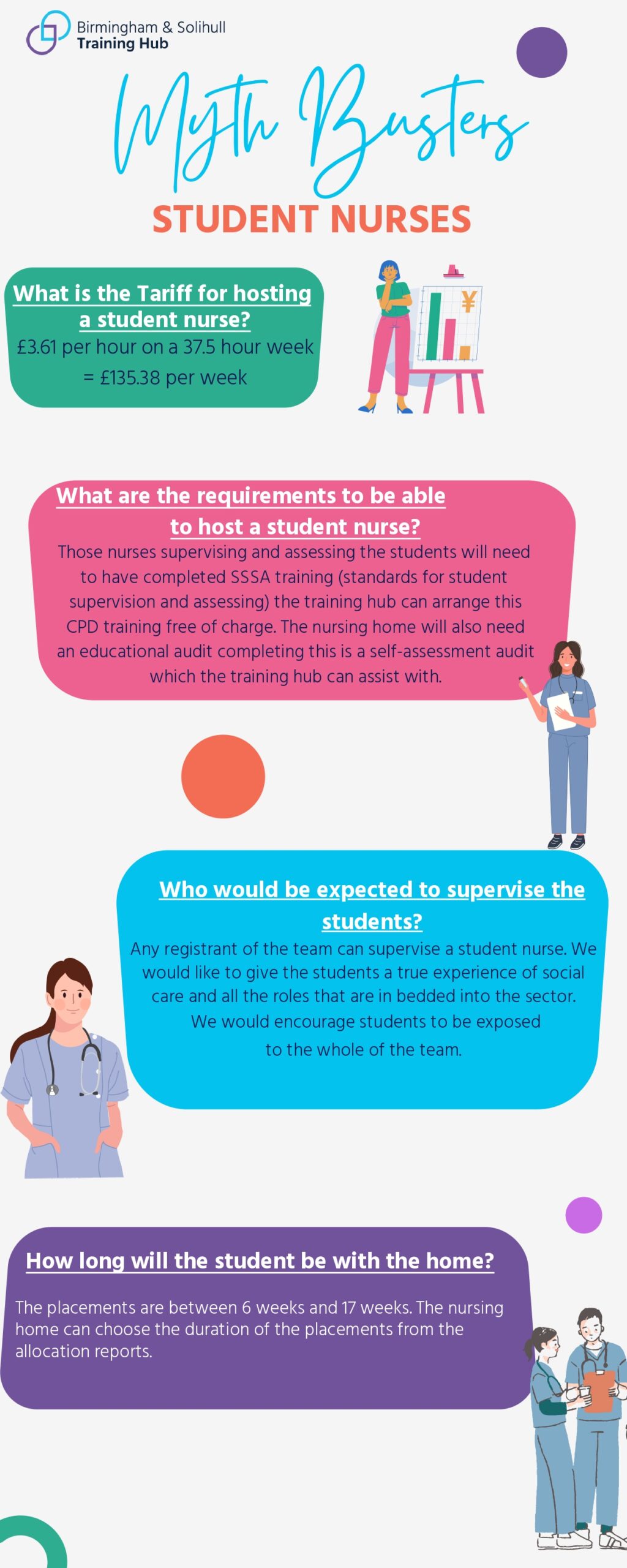
INCREASE IN TARIFF FOR HOSTING STUDENT NURSES
We are pleased to announce that there has been an increase in the tariff rate. Your organisation will now receive £3.83 per hour, based on a 37.5-hour week, which equates to £143.63 per week.
Therefore, if you host a student nurse for an 8-week placement, your organisation will receive a total of £1,149.00.
Find out more about the Nursing Strategy for Social Care Placements – Social care as a placement of choice launch and implementation
Care Certificate: The Care Certificate is an agreed set of standards that define the knowledge, skills and behaviours expected of specific job roles in the health and social care sectors.
Core and Mandatory Training: Guide to developing your staff – Core and mandatory training, refreshing knowledge and skills in a variety of topic areas based on a review of legislation, guidelines, statutory guidance, standards and recommendations
Training available and how to claim funding for adult social care courses and qualifications in 2025-2026
Search this year’s list of adult social care training courses and qualifications to find opportunities for you and your team.
In order to claim funding you need to register and upload your workforce data to the Adult Social Care Workforce Data Set (ASC-WDS), a free online data collection service that covers the adult social care workforce in England.
Adult Social Care Nursing | Postgraduate | University College Birmingham (ucb.ac.uk)
All Our Health – elearning for healthcare
The All Our Health elearning sessions have been developed to provide a bite-sized introduction to the wide range of topics covered within the All Our Health framework.
Every Mind Matters: expert advice and practical tips to help you look after your mental health and wellbeing.
Wellbeing for Registered Managers: a bite- size practical guide
The Care Workers Charity
Mental health and wellbeing fund available from the Care Workers Charity, as well as crisis grants and emergency fund.
Helplines for social care workers
■ Shout provides a free 24/7 text
support service.
Text FRONTLINE to 85258 to talk by text with a trained crisis volunteer.
■ Call Samaritans’ dedicated
confidential support line for free on 0800 069 6222
■ Call Hospice UK grief, bereavement and trauma line 0300 030 4434 free and in confidence
Talk To Us– The Queen’s Nursing Institute (QNI) is offering an emotional support phoneline called TalkToUs for nurses working in the community, including nursing and residential homes. Here is the link: https://qni.org.uk/support-for-nurses/talktous/
A full list of training courses and qualifications eligible for funding under the Learning and Development Support Scheme (LDSS) follows. Only the specific training courses and qualifications listed below are eligible for LDSS funding.
The list also sets out the maximum reimbursement amount per item, per learner. This amount reflects the maximum, not default, reimbursement amount that an employer can receive. Where the evidenced spend for a course is lower than the payment cap for that specific course, the reimbursement will be for the evidenced spend only. No adult social care (ASC) employer will be reimbursed more than the value of any legitimate evidenced spend.
This list may be subject to change, and we recommend that ASC employers check the course list prior to paying for training for their staff. Those with accounts registered on the online claims service will be notified of any changes to the course list.
See the website for full details; Eligible training courses and qualifications – GOV.UK
The Care Workforce Pathway addresses workforce needs, defines clear career structures, highlights diverse careers in adult social care, provides role clarity and supports employers with a flexible approach to use the pathway in a way that suits their unique needs.
Find out more here – CWP- In a Nutshell slides – August 2025
Find out more about the Nursing Preceptorship Programme for Social Care here – WASCN preceptorship forum presentation
West Midlands Cancer Academy
The Cancer Academy is a centralised platform designed to support lifelong learning for our current, and future, cancer workforce.
Created to support our entire cancer workforce, our courses and extensive resources are aimed at enhancing your knowledge and helping you stay skilled and up to date in all thing’s cancer care.
Whether you work in a clinical setting or an administrative role, the Academy is here for you – WMCA Cancer Academy
A free programme for nurses working in social care.
Find out more here –
Please note that the NHS England Patient Safety Incident Response Framework will soon be implemented for social care. Details will be shared soon.
For further information, please visit the NHS England website and look for the Patient Safety Incident Response Framework section. NHS England » Patient Safety Incident Response Framework
Free training is available here NHS Patient Safety Syllabus training – elearning for healthcare
New funding for Oliver McGowan Learning Disability & Autism training.
We are pleased to inform you that the funding for the Oliver McGowan Mandatory Training on Learning Disability and Autism (Oliver’s Training) has now become available to adult social care (ASC) providers registered with the Care Quality Commission (CQC). Under the Health and Care Act 2022, CQC-registered providers are required to ensure their staff receive specific training on learning disability and autism appropriate to their role.
Funding is now available via the same online claims service as the Learning and Development Support Scheme (LDSS). This will operate under the same arrangements that currently apply, with training completed between 1st April 2025 and 31st March 2026 eligible for reimbursement. The funding for Oliver’s Training is a separate pot to the overall LDSS funding already available for other training and qualifications.
Guidance on the LDSS is available here.
To submit claims for Oliver’s Training, providers will need to:
- Be registered with the CQC as a provider of ASC services.
- Make sure their organisation has an up-to-date ASC workforce dataset account which can be set up here.
- Complete the Learning and Development Support Scheme onboarding form Adult Social Care Development Support Scheme – Private Beta Onboarding.
- Submit a claim once Oliver’s Training has been paid for and completed, providing evidence to demonstrate this.
Funding is being provided for Oliver’s Training as it is the government’s recommended training package to meet the statutory training requirement. There are no plans to extend this funding to other courses or to providers not registered with the CQC at this stage. Providers may choose to undertake an alternative training package, which would need to meet expectations set out in the Oliver McGowan Code of Practice. CQC has guidance on how they assess this training requirement and what they expect from providers on a dedicated webpage.
We hope this brings welcome news as a crucial step to embedding training on learning disability and autism as an essential part of learning and development, and in improving outcomes for people with a learning disability and autistic people.
Join one of our ASC-WDS workshops in November to register and claim funding-https://www.gov.uk/government/publications/adult-social-care-learning-and-development-support-scheme
The Fair Pay Agreement (FPA) consultation in adult social care is now live.
All consultation materials are available via the government’s landing page.
The consultation will remain open until 16 January 2026.
The government’s press release announcing this initiative is titled “£500m for first ever fair pay agreement for care workers”. GOV.UK https://bit.ly/46RihXS
This is being done under powers in the forthcoming Employment Rights Bill, which will establish a Social Care Negotiating Body to set sector-level minimums and standards (for pay, travel time, sick pay, training, etc.). Care Provider Alliance. The first Fair Pay Agreement is expected to come into force in 2028, following the establishment of the negotiating body in 2026.
✅ What you should do (and why)
Please complete the consultation. This is a rare chance for workers, employers, and organisations in adult social care to influence how the FPA framework is designed.
Encourage colleagues, peers, and networks to respond too. The more voices heard, the more robust the final design is likely to be.
When responding, you may wish to address issues such as:
- How pay and travel time should be handled
- How different types of providers (private, not-for-profit, local authority) should be treated
- The importance of full and sustainable funding from government
- How differential pay (for more senior or specialised roles) might be preserved
- The practical burdens on smaller providers and how to mitigate them
Sharing and Celebrating Best practice in Social Care
The Outstanding Society is free to everyone – you do not need to have an Outstanding rating to be a member.
In 2021, the Outstanding Society (OS) was established as a Community Interest Company (CIC). Its primary purpose is to serve as a platform for sharing and celebrating best practices in social care while supporting others to enhance standards and elevate the visibility of the sector.
Our collective goal is to offer complimentary memberships, providing unrestricted access to our virtual events, newsletters, podcasts, and an array of valuable resources. This initiative strives to create an inclusive platform, ensuring that everyone can access information, celebrate innovation, and exchange invaluable best practices.
Find out more – Sharing & Celebrating Best Practice within Social Care
The Department for Health and Social Care have confirmed funding for 2025/26 for the Learning and Development Support Scheme
BSol Training Hub2025-04-01T04:44:19+01:0031 March 2025|Comments Off on The Department for Health and Social Care have confirmed funding for 2025/26 for the Learning and Development Support Scheme
Training and qualifications available include:Care Quality Commission assessment preparation coursesLeadership and performance management programmesSpecialist training courses focusing on mental health and mental capacity, autism, dementia, learning disabilities and end of life careTraining to support care staff ...
Resilience Based Clinical Supervision 2025
BSol Training Hub2025-03-26T14:17:37+00:0026 March 2025|Comments Off on Resilience Based Clinical Supervision 2025
Resilience Based Clinical Supervision 2025 (Information for Birmingham and Solihull Nursing Homes) Programme available to nurses and nursing associates in social care. The programme is funded by NHSE see flyer and book here RBCS for Social ...
getUBetter is a self-recovery app for people with common musculoskeletal injuries or conditions.
BSol Training Hub2025-03-26T13:58:07+00:0026 March 2025|Comments Off on getUBetter is a self-recovery app for people with common musculoskeletal injuries or conditions.
getUBetter is a safe and effective way to help you self-manage your injury or condition at home, work, and on the move. The app covers a range of musculoskeletal injuries and conditions. You will get: ...
International Recruitment Information (Information for Birmingham and Solihull Care Homes)
BSol Training Hub2025-03-26T13:52:06+00:0026 March 2025|Comments Off on International Recruitment Information (Information for Birmingham and Solihull Care Homes)
Changes to international recruitment Information for employers: here. There is a separate section on the West Midlands International Recruitment Hub for international care workers, signposting to support Click on link below: Website Link